Gabi Trend: Hop Hop Hop Dance Twin AI
Last updated:
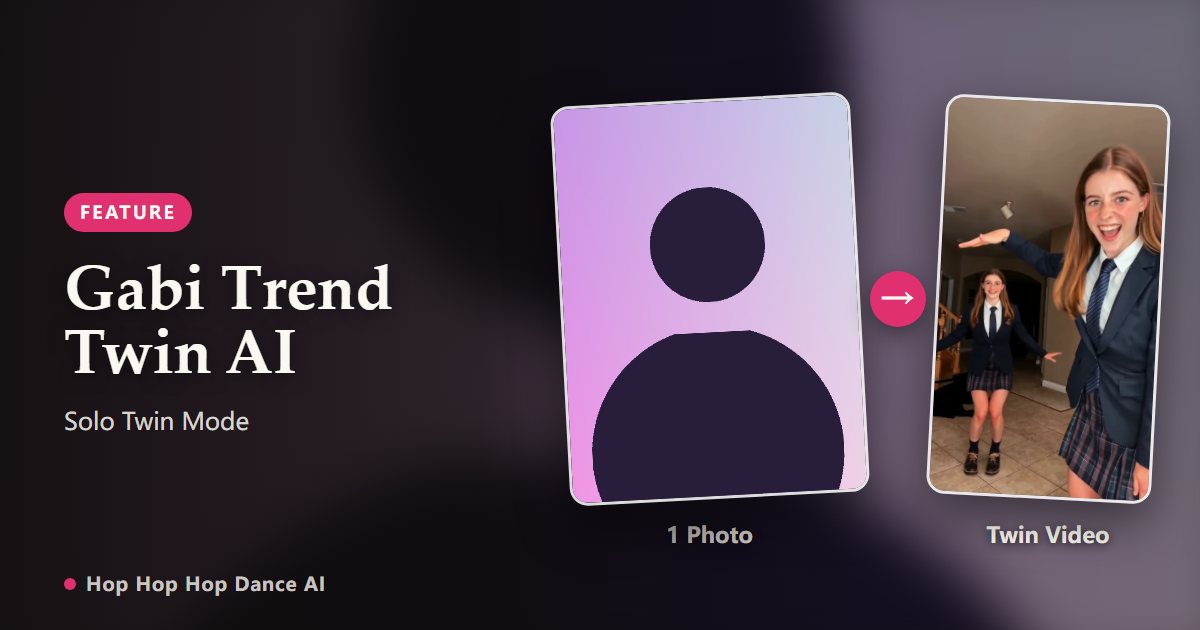
If you have browsed social media recently, you may have seen the viral Hop Hop Hop Dance challenge labeled as the “Gabi Trend” or “Twin Dance Meme”. In this version, rather than two different creators performing together, a single person magically stars as both the mischievous foreground pointer and the bouncing background dancer. Here is the complete breakdown of the Gabi Trend phenomenon and how you can create your own solo twin video from just one photo.
What is the "Gabi Trend"? Unpacking the viral TikTok twin meme
The term “Gabi Trend” gained viral traction across TikTok and Instagram edits as creators and fans used it to describe the comedic twin format of the Hop Hop Hop Dance challenge. Originating in Eastern European and Brazilian short-form dance communities, the meme features an identical "twin" or clone of the subject appearing in the background corridor.
The comedic payoff centers on sibling rivalry or self-mockery: the foreground "twin" points backward with an amused smirk, setting up their background "twin" to hop three times before being comically flattened by a forced-perspective palm and instantly trading places.
Solo Twin Mode: How neural networks transform 1 photo into a duo dance
Producing a twin video in real life requires filming two separate takes on a locked tripod, carefully maintaining lighting, masking halves of the frame, and painstakingly matching body speed in post-production. With Hop Hop Hop Dance AI’s Solo Twin Mode, all of this is handled by a single neural inference pass.
You provide only one single portrait photo. The AI isolates your facial identity and wardrobe features, instantiates two coherent character models, places one in the extreme foreground and the other in the corridor depth, and executes the synchronized swap on beat four without any identity drift.
Why twin meme videos explode on TikTok, Reels, and YouTube Shorts
Algorithmically, Solo Twin videos consistently outperform standard single-person clips because they tap directly into viewer curiosity. When a viewer scrolls onto the video, the immediate visual question is: "Wait, are they actual twins, or is that a clone?"
This double-take drives high loop completion rates and triggers massive comment section engagement. Creators frequently leverage viral captions such as “Me dealing with my last two brain cells”, “Twin A vs. Twin B”, or “Who did the hop better: Me or Myself?” to ignite comment discussions.
Step-by-step: Crafting the perfect Solo Twin video from one portrait
To achieve the most convincing and hilarious twin video results, choose a high-resolution, front-facing portrait with clear facial contours and distinct clothing textures (like a denim jacket, hoodie, or graphic tee).
Avoid photos with heavy motion blur, dark sunglasses, or extreme wide-angle distortion. A photo with a playful, expressive facial expression—such as an eyebrow raise or confident smirk—gives your twin clone maximum personality during the transition cut.
Audio sync: Pairing your export with Shluzov’s “Её парень”
Every Gabi Trend export from Hop Hop Hop Dance AI is pre-timed to 9 seconds, perfectly aligned with the slowed-and-reverb edition of “Её парень” by Russian artist Shluzov.
Download your watermark-free 9:16 vertical MP4, open TikTok or Instagram, search for the official “Hop Hop Hop” / “Её парень” audio, and set the original video sound volume to match. The stomping beats and bass-drops will synchronize flawlessly with your twin moves.
Ready to drop into the Hop Hop Hop Dance trend?
Create my video